


Student Cockpit

  • ePayment
  • Termin- & LV-Management

Campus-System

  • Forschungsdokumentation
  • Campus Suche

Beschäftigten-Portal

  • Organisationshandbuch
  • Betriebsmitteilungen, Interne & Persönliche Mitteilungen

Links

  • Bibliothek
  • Webmail
  • Stellenausschreibungen
  • Mitteilungsblätter
  • Schwarzes Brett
  • Personensuche
  • Campus Plan
  • IT Services (ZID)
  • Center for University Learning and Teaching
  • Familienservice
  • USI
  • ÖH Klagenfurt

Informationen für

  • Schüler:innen
  • Studieninteressierte
  • Studierende
  • International
  • Weiterbildung
  • Wissenschaftler:innen
  • Mitarbeiter:innen
  • Lehrende
  • Menschen mit Behinderungen
  • Alumni & Karriere
  • Partner:innen & Förder:innen
  • Medien

Gütesiegel evalagZertifikat 2024: Vielfalt gestalten. Diversity Audit des StifterverbandsGütesiegel Betriebliche GesundheitsförderungLogo Satisfaction Award 2023Satisfaction Award 2021EMAS SiegelGütezeichen hochschuleundfamilie Gütezeichen EqualitaDie Fakultät für Wirtschafts- und Rechtswissen­schaften der Universität Klagenfurt wurde von AACSB International akkreditiert

English
search
Quicklinks +
  • English English Englisch en
  • Deutsch Deutsch Deutsch de
  • Link zu Instagram
  • Link zu Facebook
  • Link zu TikTok
  • Link zu Youtube
  • Link zu Bluesky
  • Link zu LinkedIn
Universität Klagenfurt
  • Home
  • Universität
        • Organisation
          • Leitung
          • Studienrecht & -organisation
          • Fakultäten, Institute & Fakultätszentren
          • Universitätszentren
          • Stabsstellen
          • Administration & Verwaltung
          • Interessensvertretungen & Beauftragte
          • Organisationsplan
          • Satzung
        • Profil
          • Leitbild
          • Strategie
          • Geschichte der Universität
          • Ehrentafel
          • Gender & Gleichstellung
          • Kärntner Hochschulkonferenz
          • Alpen-Adria-Rektor:innen-Konferenz
          • Fakten, Zahlen, Daten
        • Campus
          • Rund um den Campus
          • Kunst und Kultur
          • Wohnen
          • Gastronomie
          • Sport und Freizeit
          • Green Campus
          • Parkplätze und Parkordnung
          • Sanierung
          • 50 Jahre Universität Klagenfurt
          • Die UNI radelt
          • Der Shop der Universität Klagenfurt
        • Service & Kontakt
          • Stellenausschreibungen
          • Mitteilungsblatt
          • Partner:innen & Förder:innen
          • Veranstaltungs­management
          • Press Room
          • Services für Familien
          • Center for University Learning and Teaching
          • IT Services (ZID)
          • Services für Menschen mit Behinderungen
          • Universitätsbibliothek
  • Studium
        • Studienangebot
          • Studienübersicht
            • Bachelorstudien
            • Masterstudien
            • Lehramtsstudien
            • Doktoratsstudium
          • Englischsprachige Studien
          • Erweiterungsstudien
          • Joint und Double Degrees
          • Vertiefende Angebote & Wahlfachbereiche
          • Universitätslehrgänge
          • Microcredentials-Kurse
        • Studienorganisation
          • Termine & Fristen
          • Checkliste für den Start
          • Studienbeitrag
          • Studienzulassung
          • Studienbeginn
          • Studienverlauf
          • Studienabschluss
          • Suche nach Lehrveranstaltungen
        • Studentisches Leben
          • DISCOVER Uni Klagenfurt
          • Campus
          • Wohnen
          • Gastronomie
          • Barrierefrei Studieren
          • Sport & Freizeit
          • Studieren & Arbeiten
          • Studieren & Familie
          • Stipendien & Zuschüsse
          • Anlaufstellen & Services
        • International Studieren
          • Studieren im Ausland
          • Studieren in Klagenfurt
          • Sommerschulen
          • Service & Beratung
        • Service & Information
          • Studien- und Prüfungsabteilung
          • Studienrektorat
          • International Office
          • Studieninformation
          • Tutoring & Mentoring (Studierendenberatung)
          • ÖH Klagenfurt
          • Ombudsstelle für Studierende
          • Alumni & Karriere
          • Universitätsbibliothek
          • SchreibCenter (SC)
  • Forschung
        • Forschungsprofil
          • Grants & Winners
          • Forschungsschwerpunkte
          • Sustainable Development Goals
          • Forschungsinfrastruktur
          • Karl Popper Kolleg
          • Ada Lovelace Programm
          • Open Access
          • Wissenstransfer
          • Institutionelle Kooperationen
        • Early Career
          • Doktoratsprogramme
          • Young Scientists Mentoring
          • Doc.Service
          • PromoLi – Promotion ohne Limit
          • Weiterbildung für Early Career Researchers
        • Research Support
          • Forschungsrat
          • Forschungsservice
          • Forschungsförderung
          • Forschungsdokumentation (FoDok)
          • Ethikrat
          • Gute Wissenschaftliche Praxis
          • Forschungskommunikation
  • International
        • Internationales Profil
          • Internationales Studienangebot
          • Partneruniversitäten
        • Studieren im Ausland
          • Erasmus+ Studienaufenthalte
          • Joint-Study
          • Joint & Double Degrees
          • Kurzfristiges wissenschaftliches Arbeiten im Ausland (KWA)
          • Weitere Förderungen
          • Sommerschulen
          • FAQ für Outgoing-Studierende
        • Studieren in Klagenfurt
          • Studierende in Mobilitätsprogrammen
          • Einreise und Aufenthalt (VISUM)
          • Unterkunft
          • MORE-Programm für Menschen mit Fluchthintergrund
          • Unterstützung für Studierende aus der Ukraine
        • Arbeiten im Ausland
          • Lehrende
          • Wissenschaftlicher Nachwuchs
          • Allgemeines Personal
          • Erasmus+ Studierendenpraktika
          • Fachspezifisches Praktikum weltweit
          • Deutsch lehren im Ausland
        • Service & Beratung
          • International Office
          • Studien- & Prüfungsabteilung
          • ÖH Referat für Internationale Studierende
          • Deutsch in Österreich
          • Sprachzertifikate
          • SchreibCenter (SC)

INSTITUT FÜR MATHEMATIK

AAU1/Institut für Mathematik2/Fachbücher

Fachbücher

Eine vollständige Liste aller am Institut für Mathematik verfassten Fachbücher finden Sie in der Forschungsdokumentation (FoDok).

Ausgewählte Fachbücher

Barbara Kaltenbacher, William Rundell: Inverse Problems for Fractional Partial Differential Equations, American Mathematical Society, US Providence (RI), 2023

As the title of the book indicates, this is primarily a book on partial differential equations (PDEs) with two definite slants: toward inverse problems and to the inclusion of fractional derivatives. The standard paradigm, or direct problem, is to take a PDE, including all coefficients and initial/boundary conditions, and to determine the solution. The inverse problem reverses this approach asking what information about coefficients of the model can be obtained from partial information on the solution. Answering this question requires knowledge of the underlying physical model, including the exact dependence on material parameters.

The last feature of the approach taken by the authors is the inclusion of fractional derivatives. This is driven by direct physical applications: a fractional derivative model often allows greater adherence to physical observations than the traditional integer order case.

The book also has an extensive historical section and the material that can be called „fractional calculus“ and ordinary differential equations with fractional derivatives. This part is accessible to advanced undergraduates with basic knowledge on real and complex analysis. At the other end of the spectrum, lie nonlinear fractional PDEs that require a standard graduate level course on PDEs.

Vasso Anagnostopoulou, Christian Pötzsche, Martin Rasmussen: Nonautonomous Bifurcation Theory, Springer, Cham, 2023

Bifurcation theory is a major topic in dynamical systems theory with profound applications. However, in contrast to autonomous dynamical systems, it is not clear what a bifurcation of a nonautonomous dynamical system actually is, and so far, various different approaches to describe qualitative changes have been suggested in the literature. The aim of this book is to provide a concise survey of the area and equip the reader with suitable tools to tackle nonautonomous problems. A review, discussion and comparison of several concepts of bifurcation is provided, and these are formulated in a unified notation and illustrated by means of comprehensible examples. Additionally, certain relevant tools needed in a corresponding analysis are presented.

Barbara Kaltenbacher, Thomas Schuster, Anne Wald: Time-dependent Problems in Imaging and Parameter Identification, Springer, Heidelberg, 2021

Inverse problems such as imaging or parameter identification deal with the recovery of unknown quantities from indirect observations, connected via a model describing the underlying context. While traditionally inverse problems are formulated and investigated in a static setting, we observe a significant increase of interest in time-dependence in a growing number of important applications over the last few years. Here, time-dependence affects a) the unknown function to be recovered and / or b) the observed data and / or c) the underlying process. Challenging applications in the field of imaging and parameter identification are techniques such as photoacoustic tomography, elastography, dynamic computerized or emission tomography, dynamic magnetic resonance imaging, super-resolution in image sequences and videos, health monitoring of elastic structures, optical flow problems or magnetic particle imaging to name only a few. Such problems demand for innovation concerning their mathematical description and analysis as well as computational approaches for their solution.

Gert Kadunz: Zeichen und Sprache im Mathematikunterricht, Springer, Heidelberg, 2020

This volume presents different aspects of teaching and learning mathematics from the perspective of Peirce’s semiotics. The contributions demonstrate the flexibility of this tool from both a practical and theoretical point of view.

The range of topics is diverse: there are texts on the visualization of mathematics at different school levels, on sign language, on gesture research, and on multilingual mathematics teaching. One contribution describes the visible as a means of creativity for constructing new knowledge, while another traces the reconstruction of diagrammatic reasoning. In addition, a perspective on learning mathematics is presented that does not rely on restrictive ontological assumptions.

Barbara Kaltenbacher, Igor Kukavica, Irena Lasiecka, Roberto Triggiani, Amjad Tuffaha, Justin T. Webster: Mathematical Theory of Evolutionary Fluid-Flow Structure Interactions, Springer, Cham, 2018

This book is devoted to the study of coupled partial differential equation models, which describe complex dynamical systems occurring in modern scientific applications such as fluid/flow-structure interactions. The first chapter provides a general description of a fluid-structure interaction, which is formulated within a realistic framework, where the structure subject to a frictional damping moves within the fluid. The second chapter then offers a multifaceted description, with often surprising results, of the case of the static interface; a case that is argued in the literature to be a good model for small, rapid oscillations of the structure. The third chapter describes flow-structure interaction where the compressible Navier-Stokes equations are replaced by the linearized Euler equation, while the solid is taken as a nonlinear plate, which oscillates in the surrounding gas flow. The final chapter focuses on a the equations of nonlinear acoustics coupled with linear acousticsor elasticity, as they arise in the context of high intensity ultrasound applications.

Nicolo Gusmeroli: Machine Scheduling to Minimize Weighted Completion Times, Springer, Heidelberg, 2018

This work reviews the most important results regarding the use of the α-point in Scheduling Theory. It provides a number of different LP-relaxations for scheduling problems and seeks to explain their polyhedral consequences. It also explains the concept of the α-point and how the conversion algorithm works, pointing out the relations to the sum of the weighted completion times. Lastly, the book explores the latest techniques used for many scheduling problems with different constraints, such as release dates, precedences, and parallel machines. This reference book is intended for advanced undergraduate and postgraduate students who are interested in scheduling theory. It is also inspiring for researchers wanting to learn about sophisticated techniques and open problems of the field.

Gert Kadunz, Norma Presmeg, Luis Radford, Michael Roth: Semiotics in Mathematics Education, Springer, Berlin, 2016

This volume discusses semiotics in mathematics education as an activity with a formal sign system, in which each sign represents something else. Theories presented by Saussure, Peirce, Vygotsky and other writers on semiotics are summarized in their relevance to the teaching and learning of mathematics. The significance of signs for mathematics education lies in their ubiquitous use in every branch of mathematics. Such use involves seeing the general in the particular, a process that is not always clear to learners. Therefore, in several traditional frameworks, semiotics has the potential to serve as a powerful conceptual lens in investigating diverse topics in mathematics education research. Topics that are implicated include (but are not limited to): the birth of signs; embodiment, gestures and artifacts; segmentation and communicative fields; cultural mediation; social semiotics; linguistic theories; chains of signification; semiotic bundles; relationships among various sign systems; intersubjectivity; diagrammatic and inferential reasoning; and semiotics as the focus of innovative learning and teaching materials.
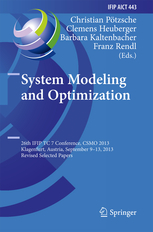
Christian Pötzsche, Clemens Heuberger, Barbara Kaltenbacher, Franz Rendl: System Modeling and Optimization, Springer, Heidelberg, 2014

This book is a collection of thoroughly refereed papers presented at the 26th IFIP TC 7 Conference on System Modeling and Optimization, held in Klagenfurt, Austria, in September 2013. The 34 revised papers were carefully selected from numerous submissions. They cover the latest progress in a wide range of topics such as optimal control of ordinary and partial differential equations, modeling and simulation, inverse problems, nonlinear, discrete, and stochastic optimization as well as industrial applications.
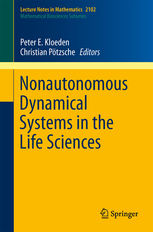
Peter Kloeden, Christian Pötzsche: Nonautonomous dynamical systems in the life sciences, Springer, Heidelberg, 2013

Nonautonomous dynamics describes the qualitative behavior of evolutionary differential and difference equations, whose right-hand side is explicitly time dependent. Over recent years, the theory of such systems has developed into a highly active field related to, yet recognizably distinct from that of classical autonomous dynamical systems. This development was motivated by problems of applied mathematics, in particular in the life sciences where genuinely nonautonomous systems abound. The purpose of this monograph is to indicate through selected, representative examples how often nonautonomous systems occur in the life sciences and to outline the new concepts and tools from the theory of nonautonomous dynamical systems that are now available for their investigation.
Thomas Schuster, Barbara Kaltenbacher, Bernd Hofmann, Kamil S. Kazimierski: Regularization Methods in Banach Spaces, de Gruyter, Berlin, 2012

Regularization methods aimed at finding stable approximate solutions are a
necessary tool to tackle inverse and ill-posed problems. Inverse problems arise in
a large variety of applications ranging from medical imaging and nondestructive
testing via finance to systems biology. Many of these problems
belong to the class of parameter identification problems in partial differential
equations (PDEs) and thus are computationally demanding and mathematically
challenging. Hence there is a substantial need for stable and efficient solvers for
this kind of problems as well as for a rigorous convergence analysis of these
methods.
This monograph consists of five parts. Part I motivates the importance of
developing and analyzing regularization methods in Banach spaces by
presenting four applications which intrinsically demand for a Banach space
setting and giving a brief glimpse of sparsity constraints. Part II summarizes all
mathematical tools that are necessary to carry out an analysis in Banach spaces.
Part III represents the current state-of-the-art concerning Tikhonov
regularization in Banach spaces. Part IV about iterative regularization methods is
concerned with linear operator equations and the iterative solution of nonlinear
operator equations by gradient type methods and the iteratively regularized
Gauß-Newton method. Part V finally outlines the method of approximate inverse
which is based on the efficient evaluation of the measured data with
reconstruction kernels.

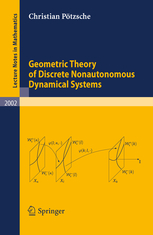
Christian Pötzsche: Geometric theory of discrete nonautonomous dynamical systems, Springer, Heidelberg, 2010

Nonautonomous dynamical systems provide a mathematical framework for temporally changing phenomena, where the law of evolution varies in time due to seasonal, modulation, controlling or even random effects. Our goal is to provide an approach to the corresponding geometric theory of nonautonomous discrete dynamical systems in infinite-dimensional spaces by virtue of 2-parameter semigroups (processes). These dynamical systems are generated by implicit difference equations, which explicitly depend on time. Compactness and dissipativity conditions are provided for such problems in order to have attractors using the natural concept of pullback convergence. Concerning a necessary linear theory, our hyperbolicity concept is based on exponential dichotomies and splittings. This concept is in turn used to construct nonautonomous invariant manifolds, so-called fiber bundles, and deduce linearization theorems. The results are illustrated using temporal and full discretizations of evolutionary differential equations.
Barbara Kaltenbacher, Andreas Neubauer, Otmar Scherzer: Iterative Regularization Methods for Nonlinear Ill-Posed Problems, De Gruyter, Berlin, 2008

Nonlinear inverse problems appear in many applications, and typically they lead
to mathematical models that are ill-posed, i.e., they are unstable under data
perturbations. Those problems require a regularization, i.e., a special numerical
treatment. This book presents regularization schemes which are based on
iteration methods, e.g., nonlinear Landweber iteration, level set methods,
multilevel methods and Newton type methods.

  • Institut für Mathematik
    • Aktuelles
      • Mathematik in der Praxis
    • Studium
      • Informationen zum Studium
      • Bachelorstudium: Lehrveranstaltungen Erweiterungsfach
      • Empfohlener Studienverlauf Bachelorstudium
      • Lehrveranstaltungskalender
      • Bachelor- und Masterarbeiten
      • FUNktionen-Raum
      • Warum Mathematik?
    • Arbeitsgruppen
      • Diskrete Mathematik
      • Diskrete Optimierung
      • Dynamische Systeme
        • Abschlussarbeiten (Dyn. Systeme)
        • Forschungsinteressen (Dyn. Systeme)
        • Gäste (Dyn. Systeme)
      • Inverse Probleme
      • Stochastische Optimierung
    • Fachbücher
      • Software
    • Team
    • Angebot für Schüler*innen
    • MSO doctoral program
      • People
        • Faculty Members
        • Former Students
        • Karl Popper Fellows
      • Events
        • DK Retreat 2017
        • DK Retreat 2015
        • Kick-Off Day
      • DK Seminar
      • Contacts
    • Gäste und Vorträge
    • Kontakt

Quicklinks

  • Bibliothek
  • Webmail
  • Stellenausschreibungen
  • Mitteilungsblatt
  • Schwarzes Brett
  • Personensuche
  • Campus Plan
  • IT Services (ZID)
  • Familienservice
  • USI
  • ÖH Klagenfurt
  • Index A-Z

Plattformen

  • Campus-­System
  • Student Cockpit
  • Beschäftigten-­Portal
  • Moodle
  • Facebook
  • Bluesky
  • LinkedIn
  • Youtube
  • Instagram
  • TikTok
Siegel der Alpen-Adria-Universität Klagenfurt

Informationen für

  • Schüler:innen
  • Studieninteressierte
  • Studierende
  • International
  • Weiterbildung
  • Wissenschaftler:innen
  • Mitarbeiter:innen
  • Lehrende
  • Menschen mit Behinderungen
  • Alumni & Karriere
  • Partner:innen & Förder:innen
  • Medien

Adresse

Universität Klagenfurt
Universitätsstraße 65-67
9020 Klagenfurt am Wörthersee
Austria

+43 463 2700
uni [at] aau [dot] at
www.aau.at
Campus Plan
Anreise
Gütesiegel evalag Zertifikat 2024: Vielfalt gestalten. Diversity Audit des Stifterverbands Gütesiegel Betriebliche Gesundheitsförderung EMAS Siegel Satisfaction Award 2023 Satisfaction Award 2021 Gütezeichen hochschuleundfamilie Logo KWF-Förderemblem Gütezeichen Equalita AACSB accredited
© Universität Klagenfurt
  • Kontakt
  • Impressum
  • AGBs
  • Datenschutzerklärung
  • Responsible disclosure
  • Hinweisportal
  • Barrierefreiheit
  • Webredaktion

Ihre Privatsphäre ist uns wichtig!


Unser Webauftritt verwendet Cookies, um die grundlegende Funktionalität unseres Webauftritts zu gewährleisten sowie unsere Webseiten für Sie optimal zu gestalten und fortlaufend zu verbessern. Dazu ist es erforderlich, Informationen an die jeweiligen Dienstanbieter weiterzugeben. Durch Betätigen des Buttons „Alle Cookies akzeptieren“ stimmen Sie der Verwendung zu.
Sie können Ihre bevorzugten Einstellungen jederzeit nachträglich unter „Einstellungen verwalten“ anpassen.
Weitere Informationen zu den verwendeten Cookies erhalten Sie in unserer Datenschutzerklärung.

Einstellungen verwaltenAlle Cookies akzeptieren

Cookies und Privatsphäre-Einstellungen


Wie wir Cookies verwenden

Wir setzen auf unserer Website Cookies ein, um unsere Webseiten für Sie optimal zu gestalten und fortlaufend zu verbessern.

Klicken Sie auf die verschiedenen Kategorienüberschriften, um mehr zu erfahren und die Standardeinstellungen zu ändern. Beachten Sie bitte, dass die Ablehnung einiger Cookies Auswirkungen auf die Funktionsweise unserer Website haben kann. Möglicherweise werden Webseiten nicht richtig dargestellt und funktionieren nicht einwandfrei.


Hinweis auf Verarbeitung Ihrer auf dieser Webseite erhobenen Daten in Staaten ohne angemessenes Datenschutzniveau:
Mit Klick auf 'Alle Cookies akzeptieren' willigen Sie gemäß Art. 49 Abs. 1 lit. a DSGVO in die Übermittlung Ihrer personenbezogenen Daten an Anbieter in Drittländern (z. B. USA) ein. Diese Anbieter (z. B. Google, Facebook, LinkedIn, Twitter, YouTube) unterliegen möglicherweise keinem der EU gleichwertigen Datenschutzniveau. Die Übermittlung erfolgt nur mit Ihrer ausdrücklichen Einwilligung.

Unbedingt erforderliche Cookies & Cookie Hinweis

Unbedingt erforderliche Cookies

Diese Cookies sind zum Funktionieren der Website erforderlich.
Essenzielle Cookies ermöglichen grundlegende Funktionen und sind für das einwandfreie Funktionieren der Website erforderlich.
Sie können Ihren Browser so einstellen, dass diese Cookies blockiert oder Sie über diese Cookies benachrichtigt werden. Einige Bereiche der Website funktionieren dann aber möglicherweis nicht wie erwartet. Diese Cookies speichern keine personenbezogenen Daten.


Ausblenden des Cookies-Hinweises

Zwei Cookies werden benötigt, damit diese Einstellung gespeichert wird. Andernfalls wird dieser Hinweis bei jedem Seitenladen wieder eingeblendet.

Google Tag Manager

Wir nutzen Tracking- und Analysetools um eine fortlaufende Optimierung und bedarfsgerechte Gestaltung unserer Webseite sicherzustellen. Mit Hilfe von Tracking-Maßnahmen ist es uns auch möglich, die Nutzung unserer Website durch Besucher statistisch zu erfassen und unser Onlineangebot mit Hilfe der dadurch gewonnenen Erkenntnisse für Sie weiterzuentwickeln.

Um zu verhindern, dass Informationen zu Ihrer Nutzung unserer Website durch Google und Facebook erfasst und übertragen werden, deaktivieren Sie das Tracking hier:

Andere externe Dienste

Wir verwenden verschiedene externe Dienste wie z. B. Google Webfonts, Google Maps oder Youtube-Videos.
Da diese Dienste personenbezogene Daten sammeln können, haben Sie die Möglichkeit diese zu blockieren. Bitte denken Sie daran, dass eine Blockierung dieser Dienste die Funktionalität und das Erscheinungsbild unserer Website beeinträchtigen kann.
Die Änderungen werden wirksam, sobald Sie die Seite neu laden.

Google Webfont Settings:

Google Maps Settings:

Google reCaptcha Settings:

Vimeo and Youtube video embeds:

Datenschutzerklärung

Weitere Informationen zu den verwendeten Cookies auf unserem Webauftritt finden Sie in den Datenschutzerklärungen der Universität Klagenfurt.

Auswahl akzeptieren und speichern Abbrechen
Nachrichtenleiste öffnen Nachrichtenleiste öffnen Nachrichtenleiste öffnen
Nach oben scrollen