




University of Klagenfurt student team qualifies as top-ranked entrant for competition at the world’s largest robotics conference
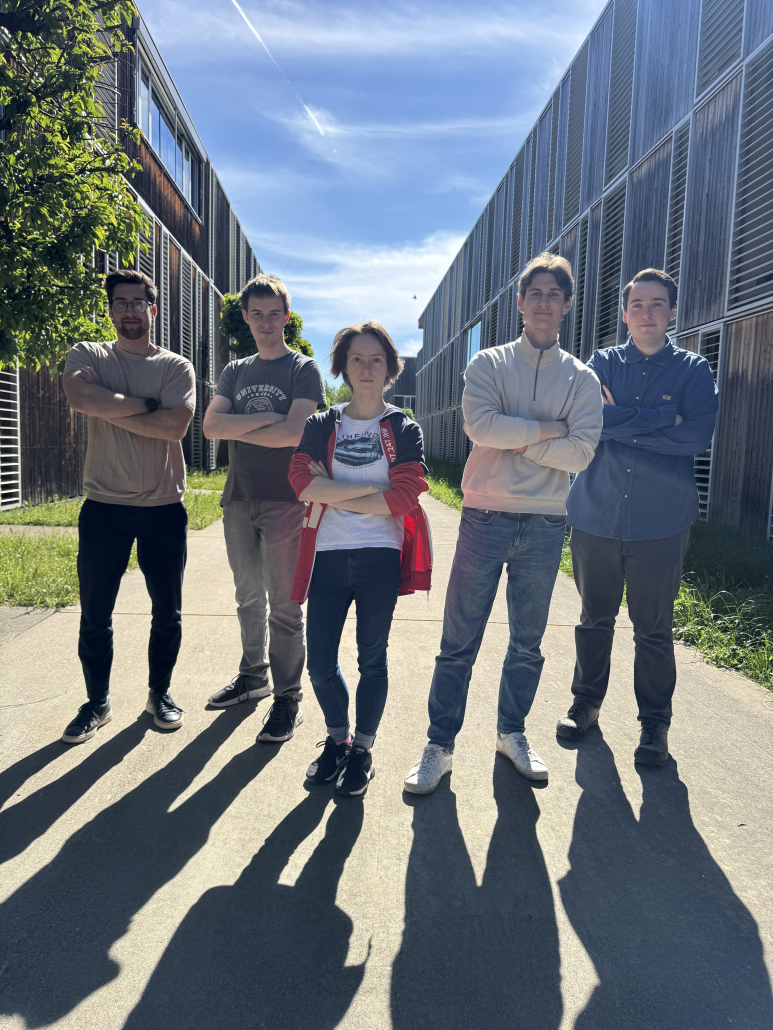
BrokenArm, a student team led by Nadezhda Varzonova, will compete in the Robotic Grasping and Manipulation Competition at the IEEE International Conference on Robotics and Automation (ICRA) from 2 to 4 June 2026. The Klagenfurt team enters the competition as one of the favourites after achieving the highest overall score in the qualification round.
Nadezhda Varzonova began her Bachelor’s degree in Robotics and Artificial Intelligence at the University of Klagenfurt in the summer semester of 2023. Half a year earlier, the software developer had moved from Russia to Austria at the age of 24 in order to pursue a stronger research focus. The English-language degree programme provided the ideal opportunity — one she quickly made the most of. Her growing enthusiasm for robotics led her to join Hubert Zangl’s Smart Systems Technology research group, where she is currently working. Her achievements to date include the Best Performer Award from the Faculty of Technical Sciences, as well as a nomination for the Best Paper Award at the Simultech conference. It was within this research environment that she decided to establish a team for the international robotics competition.
The competition includes a track dedicated to “human-to-robot handovers”, in which robots must safely receive and manipulate previously unseen objects with unknown physical properties — such as mass, stiffness, and contents — under realistic conditions involving transparency, occlusions, and reflections. It is in this category that the Klagenfurt team will compete.
“Over the past few months, I built and led this team — consisting of Daniel Bugelnig, Markus Kräuter, Valerian Pichler, and Christoph W. Rauter — entirely from the ground up,” says Nadezhda Varzonova. “This included recruiting and organising the team, defining the system architecture, coordinating development, and contributing directly to the implementation of our technologies. What began as an abstract idea evolved into a fully functional autonomous robotic system.”
The rest of the team also brings a wide range of prior experience to the table. Markus Kräuter, a graduate of HTL Mössingerstraße and a student on the Bachelor’s programme in Robotics and Artificial Intelligence, has extensive experience in software development. In 2022, he founded a software company; he is also a teaching assistant and tutor. Daniel Bugelnig graduated from the HTL for Mechatronics in Lienz and completed a Bachelor’s degree in Information Technology; he is currently studying for a Master’s in Information and Communications Engineering. In 2024, he received the Best Performer Award from the Faculty of Technical Sciences, and his Bachelor’s thesis was awarded the Carinthia State Digitalisation Scholarship. His first paper is due to appear shortly in the IEEE Internet of Things Magazine. Christoph Rauter graduated from HTL Villach and, at the age of 16, began studying at the University of Klagenfurt as part of the programme ‘Schülerinnen und Schüler an die Hochschulen’. He is currently working as a tutor. An early paper he co-authored was presented at ACSOS in Toronto in 2023. Valerian Pichler graduated from HTL Mössingerstraße and completed his Bachelor’s degree in Information Technology; he is now studying for a Master’s degree in Information and Communications Engineering. He also works as a tutor at the Faculty of Technical Sciences.
Reflecting on the qualification phase, she explains: “We had to complete the CORSMAL benchmark protocol. To do so, we carried out 288 test configurations with external volunteers and submitted our results alongside 11 other teams from leading international research groups.” The outcome has already exceeded expectations: the Klagenfurt team achieved the highest overall score in the qualification stage. This leaderboard is still dynamic. Teams are encouraged to continue improving their systems and resubmitting results, so the current ranking may still change as stronger research groups refine their solutions. At the same time, the BrokenArm team is also continuing to improve the robustness of the system, integrating tactile sensing components, and preparing a manuscript describing their approach for potential future publication.
Varzonova is particularly proud of what the team has accomplished so far: “We are a first-time team balancing this work alongside our studies and other commitments.” She also has ambitious plans for her own scientific career: “I want to contribute to advancing intelligent robotics. My research interests include improved visual assessment of unfamiliar objects, the planning of fluid movements, and tactile intelligence — enabling robots to recognise what they are currently grasping. Robotics still offers an enormous number of fascinating research challenges.” Her next academic steps are already in place: she has recently been accepted onto the Master’s programme in Robotics at EPFL (École Polytechnique Fédérale de Lausanne), Switzerland, one of the world’s leading universities in the field.
The competition takes place as part of the International Conference on Robotics and Automation (ICRA), which, following previous editions in the United Kingdom (2023), Japan (2024), and the United States (2025), will be held in Vienna in 2026. ICRA is regarded as the world’s largest robotics conference.
Nadezhda Varzonova emphasises: “Regardless of the final competition outcome, I hope this initiative continues after this year and that even stronger teams emerge in the future. In my opinion, the most important step is starting such an effort in the first place and then learning iteratively from real-world competition experience.”