








 aau/Müller
Mathematician Verena Schwarz to take up Glasstone Research Fellowship at the University of Oxford
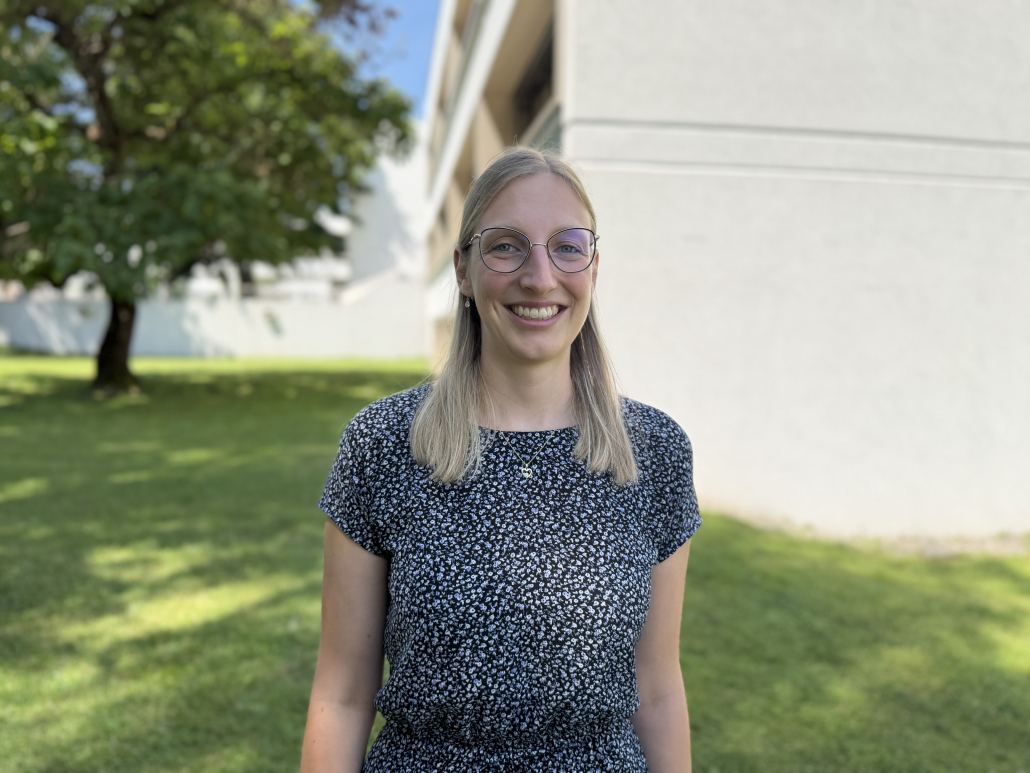
From this autumn, mathematician Verena Schwarz will conduct research at the University of Oxford for three years as holder of the renowned Glasstone Research Fellowship. In this interview, she explains why her enthusiasm for mathematics began at an early age, how research really works, and why setbacks are part of achieving successes such as this.
Verena Schwarz, what first drew you to mathematics?
Mathematics was always a subject that suited me at school. I was fascinated by logical connections, and I enjoyed solving puzzles even then. That is why I knew relatively early on that I wanted to study in this field. During my degree programme, this enthusiasm grew even stronger.
What exactly do you like about mathematics?
What interests me most is the abstract nature of mathematics. I value this world in which statements are clearly true or false. You work with assumptions and can derive clear results from them. I really like this clarity.
Is this clarity also important to you in everyday life?
In everyday life, of course, many things are much more open to interpretation. In academia in particular, there are research proposals, collaborations, and organisational questions that do not follow mathematical rules. In my research, however, I enjoy knowing exactly whether a problem has been solved or whether it still remains open.
When did you realise that you wanted to remain in academia?
During my Master’s studies, it became clear to me that I really enjoyed academic work. That is why I wanted to pursue a doctorate. After completing my Master’s degree in Germany, I came to Klagenfurt for my doctoral studies and then stayed on as a postdoctoral researcher.
How did you end up coming to Klagenfurt?
My supervisor at the time drew my attention to the position in Klagenfurt. I looked closely at the work of the academic who later became my supervisor and was immediately enthusiastic about her research topics. The fact that I ultimately got the position was a real stroke of luck.
You have achieved remarkable success in a short space of time. What does that require?
Hard work and discipline are, of course, part of it. At least as important, however, are good mentors, and people who support you and open doors. I was fortunate to come into contact with many researchers early on and to build international connections. Dialogue with other academics is especially valuable.
Have you also experienced setbacks?
Yes, setbacks are part of academia, just as they are part of life. For example, I have also had a research proposal rejected, and that should not be seen only in negative terms. I then looked closely at the feedback, and on the second attempt it worked out.
What qualities does successful research generally require?
Curiosity is probably the most important thing. You should pursue the questions that genuinely interest you. At the same time, you need structure and perseverance. Some ideas lead quickly to a result, while others occupy you for months or even years. Research rarely follows a straight path. You often work on a question for a long time, then deliberately put it aside and return to it later with a fresh perspective. Sometimes this is precisely how the decisive idea emerges. Some projects require a great deal of patience, while in others a simple thought suddenly brings the breakthrough.
Do you consider patience to be one of your strengths?
Yes, and certain experiences teach you to stay calm. I have experienced working on a problem for more than two years without finding the solution we were looking for. When we returned to the question later, it turned out that the actual solution was surprisingly simple.
You also teach students. What is your impression of the next generation?
I meet many committed young people who study mathematics with great enthusiasm. At the same time, mathematics is a subject that strongly divides opinion. Those who find a way into it often develop great enjoyment. Those who struggle, however, can quickly lose motivation. Mathematics at university is very different from what many people experienced at school: it is not about memorising calculation methods. It is much more important to understand why mathematical statements are valid and what ideas lie behind them. This way of thinking is something you first have to learn – and that was also an adjustment for me.
Is it obvious outside the university that you are a mathematician?
Probably not at first, but definitely once people get to know me better. The logical and structured way of thinking that I have learned is difficult to switch off in private life as well. But that is not a bad thing; in many situations, it is very helpful.
In the autumn, you will move to Oxford. What are you particularly looking forward to?
I have already spent time there as a visiting researcher and know several colleagues. Oxford offers an exceptionally inspiring environment. The scale is different from anything I have known so far: there are far more researchers in mathematics and many opportunities for academic exchange and collaboration. That is what I am particularly looking forward to.
Can you explain what your research focuses on?
My work focuses on stochastic models. Originally, the emphasis was on models with applications in financial and energy markets. Today, I am particularly interested in models in which many individual agents interact with one another – for example, in neural networks in the brain. I am interested in the question of how very large systems can be described mathematically and simulated efficiently. This is fundamental research, and its applications often only become visible much later.
About Verena Schwarz
Verena Schwarz completed her Bachelor’s and Master’s degrees in Mathematics and Management at Ulm University. In 2020, she moved to the University of Klagenfurt for her doctoral studies in the FWF-funded doc.funds doctoral school “Modelling – Analysis – Optimisation of discrete, continuous, and stochastic systems”, where she was supervised by Michaela Hitz. She completed her doctoral studies in 2024 and has since been working as a postdoctoral researcher at the Department of Statistics at the University of Klagenfurt.