


RESEARCH

The area of research strength Networked and Autonomous Systems (NAS) is an established and dynamic focus at the University of Klagenfurt. It is supported by three departments within the Faculty of Technical Sciences: Networked and Embedded Systems (NES), Intelligent Systems Technologies (IST) and Information Technology (ITEC). NAS thus unites the disciplines of Computer Science and Information and Communications Engineering. Its research topics include autonomous state estimation, autonomous navigation, wireless communication, sensor and camera networks, self-organising systems, swarm robotics, real-time data processing and AI-supported decision-making.
These topics are investigated and advanced through a wide range of projects, the majority of which are funded on a competitive basis. Between 2020 and 2025, more than 30 competitively acquired research and infrastructure projects can be attributed to the NAS area of research strength. Methodologically, the area spans the entire research pipeline: from theoretical foundations and mathematical modelling, through simulation and performance analysis and the generation of patents, to implementation, prototype field testing and even the establishment and scaling of its own spin-offs.
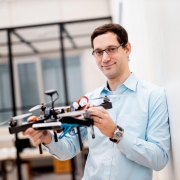
A particular distinguishing feature is its research into drone systems. The University of Klagenfurt has been active in this highly innovative field for more than 15 years and holds a pioneering position in Austria and across Europe. Especially noteworthy is the close integration of system autonomy solutions and communication technologies, which are combined into comprehensive, end-to-end system solutions.
The area of research strength maintains a broad range of collaborations with companies, including both international players and regional enterprises, thereby ensuring strong regional roots. Examples include joint projects with the Carinthian companies Bitmovin, Springer Maschinenfabrik, Infineon Technologies and Air6 Systems, as well as with the Tyrolean drone manufacturer Twins.
In addition, there are close partnerships with renowned international research institutions such as ETH Zurich, MIT, CMU, ANU, NASA, the University of Michigan, the University of Pennsylvania, Ghent University, Nantes University and Georgia Tech, as well as with regional research institutions including Lakeside Labs and Joanneum Research.
The area of research strength is seamlessly embedded in several degree programmes, enabling students to benefit directly from current, practice-oriented research projects. The market for autonomous networked technologies is expanding across sectors such as agriculture, transport, industry and the entertainment sector, offering graduates outstanding entry-level and long-term career prospects.
Karl Popper Kolleg FruitScope:
Since January 2026, the area of research strength has been running a Karl Popper Research and Doctoral College (KPK) entitled FruitScope: DroneScope for Smart Agriculture. This initiative continues the successful cross-departmental collaboration in drone research established in recent years and provides funding for four early career researchers. In addition to the individual doctoral projects, a distinctive element of the programme is the implementation of a joint case study on the contactless detection of fruit ripeness.
Spin-offs:
In recent years, two successful start-ups have emerged from the research activities of the area of research strength: Avemoy and LoconIQ.
The technology developed by Avemoy enables commercially available drones to fly and navigate autonomously and robustly in unknown environments without GPS. Its primary focus is data-driven greenhouse monitoring, where AI-supported sensor streams analyse plant conditions, detect disease and predict optimal harvest times.
LoconIQ develops and markets high-precision localisation and tracking systems based on ultra-wideband radio technology and patented algorithms. These systems are used in logistics and for asset tracking in industrial environments, for example in the pharmaceutical industry.
Selected publications:
Rinner, C. Bettstetter, H. Hellwagner, S. Weiss. Multidrone systems: More than the sum of the parts. IEEE Computer, 2021. https://doi.org/10.1109/MC.2021.3058441
Scherer, A. Schoellig, B. Rinner. Min-max vertex cycle covers with connectivity constraints for multi-robot patrolling. IEEE Robotics and Automation Letters, 2022. https://doi.org/10.1109/LRA.2022.3193242
Brommer, A. Fornasier, M. Scheiber, J. Delaune, R. Brockers, J. Steinbrener, S. Weiss. The INSANE dataset: Large number of sensors for challenging UAV flights in Mars analog, outdoor, and out-/indoor transition scenarios. The International Journal of Robotics Research, 2024. https://doi.org/10.1177/02783649241227245
Sende, C. Raffelsberger, C. Bettstetter. Bridging the reality gap in drone swarm development through mixed reality. Autonomous Robots, 2024. https://doi.org/10.1007/s10514-024-10169-1
Amirpour, M. Ghanbari, C. Timmerer. DeepStream: Video streaming enhancements using compressed deep neural networks. IEEE Transactions on Circuits and Systems for Video Technology, 2025. https://doi.org/10.1109/TCSVT.2022.3229079
Fornasier, Y. Ge, P. van Goor, R. Mahony, S. Weiss. Equivariant symmetries for inertial navigation systems. Automatica, 2025. https://doi.org/10.1016/j.automatica.2025.112495
Fontana, T. Jantos, J. Steinbrener, L. Cinque, G. L. Foresti, B. Rinner. BiCrossNet: resource-efficient cross-view geolocalization with binary neural networks. Machine Learning: Science and Technology, 2025. https://doi.org/10.1088/2632-2153/adfa67
K. Sar, K. O’Keeffe, J. Lizarraga, M. de Aguiar, C. Bettstetter, D. Ghosh. Interplay of sync and swarm: Theory and application of swarmalators. Physics Reports, 2026. https://doi.org/10.1016/j.physrep.2026.01.002
Examples of ongoing research activities

Outdoor Drone Space Austria (ODSA) at the University of Klagenfurt nears completion

More trees, less CO2: swarms of drones to reforest woodlands

Inspecting Critical Infrastructure such as Power Masts or Railway Tracks with Drones: University of Klagenfurt project receives funding from the Christian Doppler Research Association

Flying to victory with the best drones

Team from the University of Klagenfurt wins drone competition in Huntsville, USA

Robots gain new function: algorithm automatically recognises sensors and their mathematical modelling

A challenge for swarm robotics: using multiple drones to jointly transport a package

Robot swarms that scan an entire area

New skin for gripping arms aims to enable robots to sort used textiles

AI-controlled drone swarms to inspect wind turbines in the future

Improved accuracy and robustness in drone localisation: Award of Excellence for Alessandro Fornasier

Location-aware robotic vehicles: a universal approach paves the way for a wider range of applications
Research coordinators